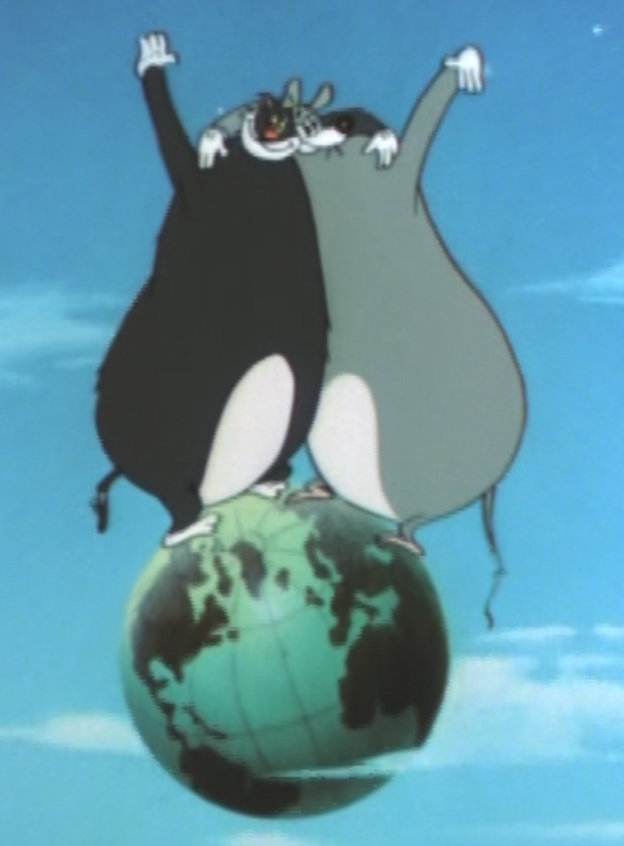
Dans son dessin animé Kingsize Canari (Un canari grand format), Tex Avery met en scène le combat d’un chat, d’une souris, d’un canari et d’un chien qui utilisent pour maîtriser leur proie un flacon d’engrais rapide destiné aux plantes qui les fait grandir instantanément. En se subtilisant successivement le flacon, le chat et la souris deviennent toujours plus grands, au point d’atteindre puis de dépasser la taille du globe terrestre, qui ne semble plus en capacité de les supporter. Les deux protagonistes se tournent alors vers le spectateur et lui disent l’air désappointé :
Mesdames et messieurs. Nous devons arrêter l’histoire ici. Nous sommes à court de produit. Bonne nuit !
Le scénario est classique des dessins animés de Tex Avery, souvent fondés sur un principe d’accumulation, d’exagération et d’accélération du même processus répété sans cesse jusqu’à l’absurde. Le procédé est ici saisissant par la dimension géographique du crescendo fondé spatialement sur un zoom inverse, qui commence dans le salon, s’étend à la maison, déborde dans le quartier, puis investit la ville et finalement les États-Unis (signalés par quelques repères iconiques) jusqu’au globe terrestre tout entier.
Réalisé en 1947, on y verra une référence (inconsciente ?) au conflit mondial qui vient de se terminer où des pays regroupés en deux alliances se sont affrontés dans une guerre de destruction totale. Ce globe devenu trop petit pour supporter deux adversaires anticipe aussi le risque que court le monde après l’usage de l’arme nucléaire durant la guerre froide entre les deux blocs dans l’après-guerre. On verra volontiers aujourd’hui dans le flacon d’engrais une allégorie des menaces pour la vie des hommes sur la planète causés par plusieurs siècles de consommation toujours plus effrénée de charbon, pétrole et autres énergies fossiles.
Irrésistiblement drôle, la répétition systématique de Tex Avery jusqu’à une situation paroxystique impossible est donc finalement plutôt angoissante. Le géodispositif du cartoon fait écho à d’autres emplois de globes dans la fiction, qui font l’objet d’autres billets. La dimension agonistique fait bien sûr penser au dictateur Henkel dansant avec son ballon-globe dans Le Dictateur, le film de Chaplin. Mais alors que le sentiment de fragilité naît chez Chaplin de la légèreté et de la transparence du ballon, Tex Avery l’associe au caractère minuscule du globe écrasé par deux êtres monstrueusement grands. Et si chez Chaplin, c’est la fragilité du rêve de pouvoir absolu d’Hitler sur le monde que symbolise l’éclatement du globe, c’est ici « notre vieux globe terraqué » lui-même qui semble sur le point de s’effondrer. Ce sentiment de fragilité est aussi souvent associé à la découverte de « Blue Marble », la première image de la Terre prise par Apollo. Il inverse en revanche les représentations courantes depuis l’Atlas Farnese, du Titan Atlas ou du héros Hercule ployant sous le poids du globe, image qui sera largement reprise au cours des siècles.
- Ce billet vous a intéressé ?
- Consultez les billets SPHEROGRAPHIA d’espace&fiction
- Visitez le site du projet SPHEROGRAPHIA
- Et n’hésitez pas à partager et commenter !
… et pour contribuer, cliquez ici
In his cartoon Kingsize Canary, Tex Avery depicts a battle between a cat, a mouse, a canary and a dog, who use a bottle of fast-acting plant fertilizer that makes them grow instantly to dominate their prey. By stealing the bottle from each other, the cat and mouse become bigger and bigger, until they reach and then exceed the size of the globe, which seems unable to support them. The two protagonists then turn to the viewer and say disappointedly:
Ladies and gentlemen, we are going to have to end the picture. We just ran out of the stuff. Good night !
The scenario is classic Tex Avery cartoon fare, often based on a principle of accumulation, exaggeration, and acceleration of the same idea repeated over and over again to a point of nonsense. The process is striking here because of the geographical dimension of the crescendo, based spatially on a reverse zoom, which begins in the living room, extends to the house, then to the neighborhood, the city, the United States (marked by a few iconic landmarks), and finally to the entire globe.
Created in 1947, it can be seen as an (unconscious?) reference to the world conflict that had just ended, in which two alliances of countries fought each other in a war of complete destruction. This globe, which has become too small to support both adversaries, also anticipates the risk facing the world after the use of nuclear weapons and the confrontation between the two post-war blocs. Today, we can also readily see in the fertilizer bottle an allegory of the threats to human life on the planet caused by several centuries of rampant consumption of coal, oil, and other fossil energies.
Irresistibly funny, Tex Avery’s systematic repetition to an impossible paroxysmal situation is actually frightening. The cartoon’s geomachinery echoes other uses of globes in fiction, which we will present in future posts. The agonistic dimension is reminiscent of the dictator Henkel dancing with his ballon-globe in Chaplin’s film The Dictator. But while Chaplin’s sense of fragility stems from the lightness and transparency of the balloon, Tex Avery associates it with the minuteness of the globe crushed by two monstrously large creatures. And while for Chaplin, the bursting of the globe symbolizes the fragility of Hitler’s dream of an absolute power over the world, here it is “our old Terraquean globe” itself that seems on the verge of collapsing.This feeling of fragility is also often associated with the discovery of Blue Marble, the first image of Earth taken by Apollo. It contrasts, however, with the Farnese Atlas, the famous statue depicting the Titan Atlas or Heracles bending under the weight of the globe, an image that has been widely disseminated over the centuries.
Found this post interesting?
- Check out the SPHEROGRAPHIA.Imaginations posts
- Visit the SPHEROGRAPHIA project website
- Please feel free to share and comment!
… and to contribute, click here!
- Work Title/Titre de l’œuvre : King Size Canary/Drôle de canari
- Author/Auteur : Tex Avery
- Year/Année : 1947
- Field/Domaine : Dessin animé/Cartoon
- Type : humour/humor
- Edition/Production :
- Language/Langue : en
- Geographical location/localisation géographique : USA
- Remarks/Notes:
- Machinery/Dispositif : Globe
- Location in work/localisation dans l’oeuvre :
- Geographical location/localisation géographique :
- Remarks/Notes :


 (e)space & fiction
Pingback: Un an de billets sur les globes pour le projet SPHEROGRAPHIA | (e)space & fiction