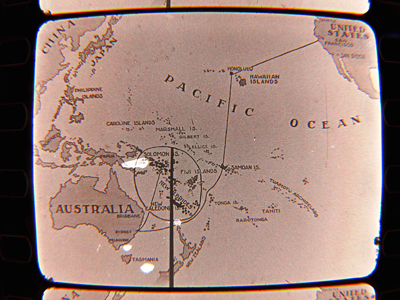
Screen capture of what may very well be the earliest animated map ever from the movie Among the Cannibal Isles of the South Pacific (Martin E. Johnson, 1918) (can 236H – Courtesy The Library of Congress NAVCC).
Is this the first animated map ever? At least it is one of the first ones. It was created for a 1918 docudrama entitled Among the Cannibal Isles of the South Pacific (Martin E. Johnson, 1918). An animated black line traces the journey of director Martin Johnson and his wife Osa from the New Hebrides Islands to the Solomon Islands in the South pacific.
Est-ce la première carte animée ? Vraisemblablement une des toutes premières. Elle a été créée pour un « docudrama » de 1918 intitulé Among the Cannibal Isles of the South Pacific (Martin E. Johnson, 1918). Une ligne noire animée représente le voyage du réalisateur Martin Johnson et de sa femme Osa depuis les Nouvelles Hébrides jusqu’aux îles Salomon dans le Pacifique Sud.
Indeed animated maps appeared in motion pictures long before they emerged from cartographers’ laboratories. While the interest in using film in cartography is rooted in the propaganda of WWII, it is in the 1950s, with the work of pioneers such as Norman Thrower in the late 1950s and 1960s, that professional cartographers began developing animated maps. At that time, cinematic maps were already common in feature films.
While Among the Cannibal Isles of the South Pacific purports to offer the first footage of these exotic communities, it contributes to the construction of geospatial archives of the time, which was one of the goals of early cinema. The Johnsons develop the narrative through the increasing danger they face by traveling through these unexplored communities. As a result, the danger increases as they travel to more and more remote locations. Footage of the Johnsons dancing at the beginning of the movie is juxtaposed with a dramatic escape from cannibals at the end. In this sense, the audience is never conscious of where reality ends and where fiction begins.
The unfolding map that shows the trip from the New Hebrides to the Solomon Islands plays on this duality. On the one hand it reinforces the veracity of documentary discourse by grounding it in existing places. On the other hand, the animated map also contributes to the narration as it increases the dramatic tension of the film. Indeed, the tension rises as both characters travel between the welcoming communities of the New Hebrides to the dangerous and savage communities of the Solomon Islands. The duality of the map as an historical record and narrative device characterizes the ambivalence of this docudrama. The map also plays a structural role as it appears at the turning point of the film; it links the first part of the film describing the “good” savages of the New Hebrides to the second part of the film depicting the “barbaric cannibals” from the Solomon Islands. This cinemap serves as a transition – a cartographic intertitle – between the close and the remote islands, the “good” and the “bad” savages.
As illustrated by this example, early cinemaps reveal different functions in docudramas. They support the documentary claim of the films by linking them to real places; they reinforce the dramatic tension of the narration; and they contribute to the dissemination of a political discourse. Of special interest to cartography is the use of animation and animated symbols in maps. This example characterizes the techniques used in early cinema in which the camera is immobile and the movement is added to films. In these early cinemaps, the camera is immobile and elements are animated, a functional technique of digital cartography, which was not developed by professional cartographers until several decades later.
Note: These paragraphs have been extracted from the following paper: Caquard S. 2009. « Foreshadowing Contemporary Digital Cartography: A Historical Review of Cinematic Maps in Films », The Cartographic Journal 46 (1): 46-55.
En effet, les cartes animées sont apparues dans les films cinématographiques bien avant qu’elles ne sortent des laboratoires des cartographes. Si l’intérêt pour l’utilisation du film en cartographie trouve son origine dans la propagande de la Seconde Guerre mondiale, c’est dans les années 1950, avec le travail de pionniers tels que Norman Thrower à la fin des années 1950 et dans les années 1960, que les cartographes professionnels ont commencé à développer des cartes animées. À cette époque, les cartes cinématographiques étaient déjà courantes dans les longs métrages.
Si Among the Cannibal Isles of the South Pacific prétend offrir les premières images de ces communautés exotiques, il contribue à la construction des archives géospatiales de l’époque, ce qui était l’un des objectifs des débuts du cinéma. Les Johnson développent le récit à travers le danger croissant auquel ils sont confrontés en voyageant à travers ces communautés inexplorées. Par conséquent, le danger augmente au fur et à mesure qu’ils se rendent dans des endroits de plus en plus reculés. Les images des Johnson dansant au début du film sont juxtaposées à une fuite dramatique devant des cannibales à la fin. En ce sens, le public ne sait jamais où la réalité s’arrête et où la fiction commence.
La carte animée qui montre le voyage des Nouvelles-Hébrides aux Îles Salomon joue sur cette dualité. D’une part, elle renforce la véracité du discours documentaire en l’ancrant dans des lieux existants. D’autre part, la carte animée contribue également à la narration en augmentant la tension dramatique du film. En effet, la tension augmente lorsque les deux personnages voyagent entre les communautés accueillantes des Nouvelles-Hébrides et les communautés dangereuses et sauvages des Îles Salomon. La dualité de la carte en tant que document historique et dispositif narratif caractérise l’ambivalence de ce docudrame. La carte joue également un rôle structurel puisqu’elle apparaît au tournant du film ; elle relie la première partie du film décrivant les « bons » sauvages des Nouvelles-Hébrides à la deuxième partie du film décrivant les « cannibales barbares » des Îles Salomon. Cette cinemap sert de transition – d’intertitre cartographique – entre les îles proches et éloignées, les « bons » et les « mauvais » sauvages.
Comme l’illustre cet exemple, les premières cinémaps révèlent différentes fonctions dans les docudrames. Elles soutiennent la prétention documentaire des films en les reliant à des lieux réels ; elles renforcent la tension dramatique de la narration ; et elles contribuent à la diffusion d’un discours politique. L’utilisation de l’animation et des symboles animés dans les cartes présente un intérêt particulier pour la cartographie. Cet exemple caractérise les techniques utilisées au début du cinéma, où la caméra est immobile et où le mouvement est ajouté aux films. Dans ces premiers films, la caméra est immobile et les éléments sont animés. Il s’agit d’une technique fonctionnelle de la cartographie numérique, qui n’a été développée par les cartographes professionnels que plusieurs décennies plus tard.
- Work Title/Titre de l’œuvre : Among the Cannibal Isles of the South Pacific
- Author/Auteur : Martin E. Johnson
- Year/Année : 1918
- Field/Domaine : Cinema/Cinéma
- Type : Docudrama
- Edition :
- Language/Langue : en (intertiles/intertitres)
- Machinery/Dispositif : Map/Carte
- Location in work/localisation dans l’œuvre : Central (turning point of the story) / Point charnière de l’histoire
- Geographical location/localisation géographique : South Pacific Ocean


Pingback: Victory Through Air Power : en 1943, Disney fait décoller l’animation cartographique | (e)space & fiction